
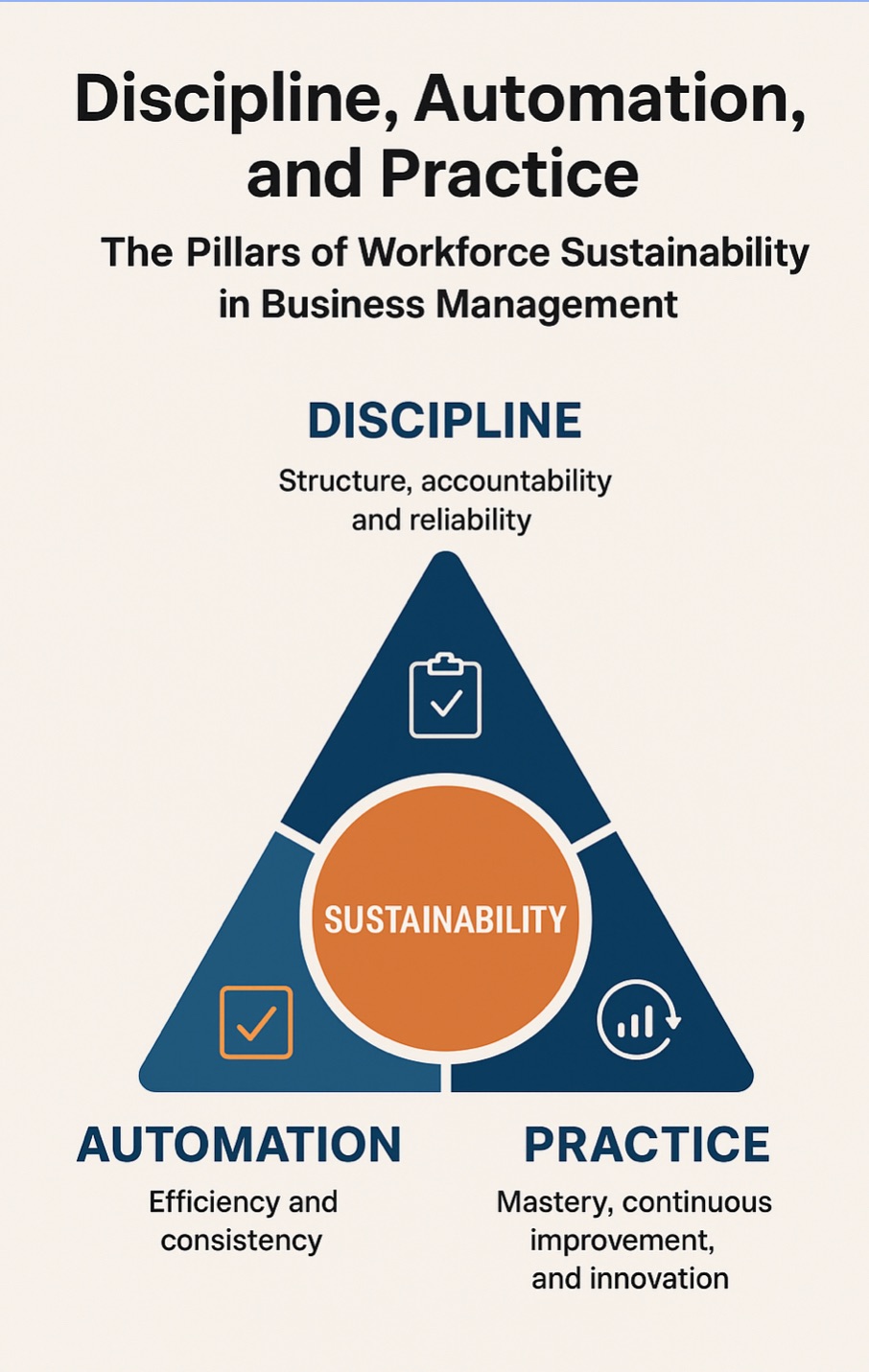
The Pillars of Workforce Sustainability in Business Management
In today’s rapidly shifting business environment, leaders face a complex challenge: how to balance discipline, automation, and human growth in order to build a workforce that is not just productive, but also sustainable. Efficiency alone is no longer enough, organizations need employees who are adaptable, resilient, and continually improving.
This is where the interplay between discipline, automation, and practice becomes crucial.
Discipline vs. Automation:
Competing or Complementary?
Traditionally, discipline has been the cornerstone of workforce management. A disciplined employee is reliable, punctual, and consistent, ensuring that work flows according to standards. Automation, however, has redefined these expectations. Tasks once reliant on human discipline, such as data entry, scheduling, or quality checks are now executed flawlessly by machines.
This raises a key question: Is discipline still relevant in the age of automation?
The answer is yes. While automation enforces consistency in systems, discipline sustains accountability and adaptability in people. The real risk lies in over-reliance on either side:
• Discipline without automation slows progress and risks burnout.
• Automation without discipline erodes responsibility and weakens ethical oversight.
The winning formula is not Discipline vs. Automation, but Discipline with Automation.
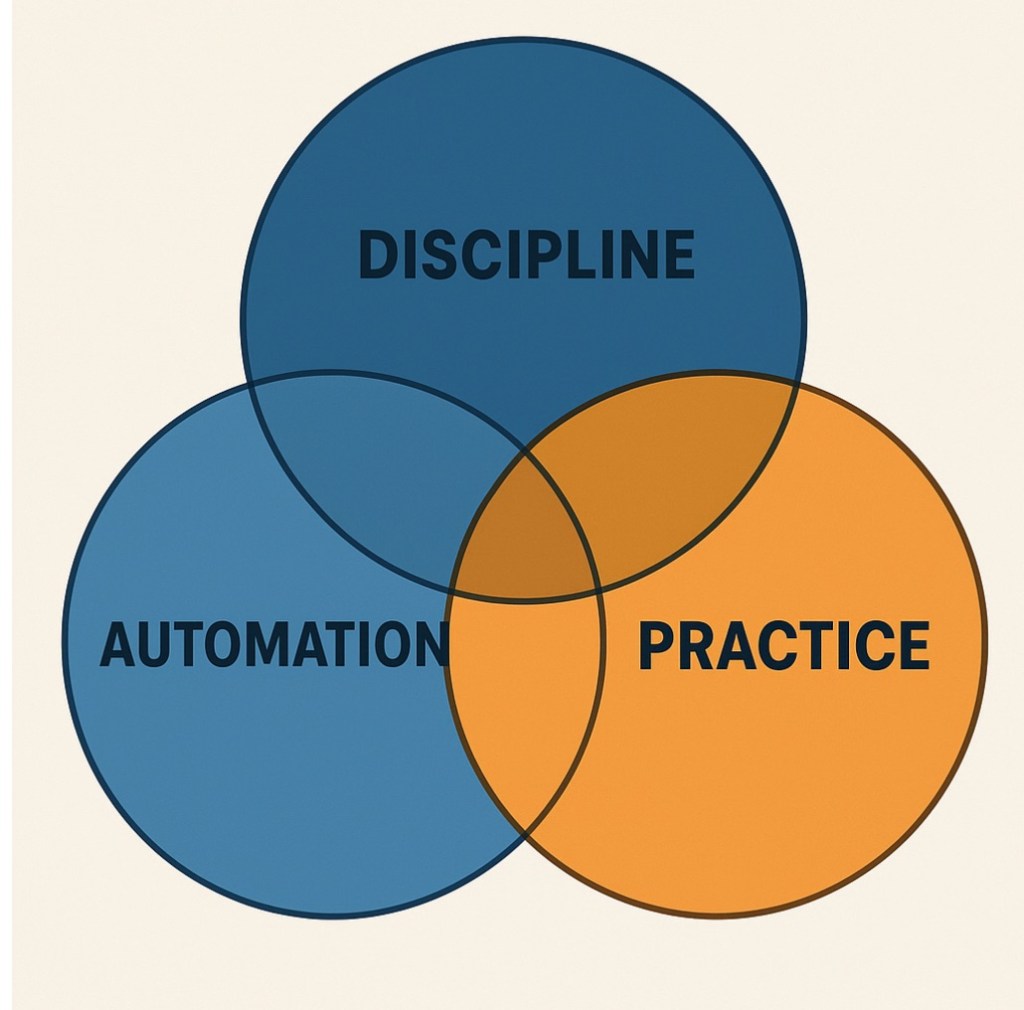
The Missing Link: Practice Makes Perfect
Where does practice fit into this equation? Practice is the method by which discipline becomes second nature. Repetition shapes habits, habits build mastery, and mastery fosters confidence.
In a workforce setting, practice ensures that employees are not only following rules but are also refining their skills. This has three key effects:
1. Turning discipline into habit – Through structured practice, consistency stops feeling like enforcement and starts becoming part of the company culture.
2. Enhancing automation – When paired with smart systems, practice helps employees master oversight and decision-making while automation handles routine tasks.
3. Building sustainability
Regular practice keeps the workforce adaptable, up-skilled, and resilient against disruptions. Instead of fearing automation, employees grow alongside it.

Workforce Sustainability:
The End Goal
Sustainability in workforce management is not just about retaining employees; it’s about enabling them to thrive in a changing environment. By combining:
• Automation for efficiency
• Discipline for accountability
• Practice for mastery
Businesses create an ecosystem where productivity and human well-being are aligned. Employees become more engaged, less prone to burnout, and better prepared for future challenges.
Leadership Takeaway
Leaders must move beyond seeing automation as a replacement for discipline or practice. Instead, they should design management systems where all three pillars support one another:
• Implement automation to free workers from repetitive tasks.
• Encourage discipline to maintain responsibility and structure.
• Foster a culture of practice where learning and improvement never stop.
When these elements converge, workforce sustainability becomes a reality, and businesses position themselves for long-term success in a competitive world.
✨ Discipline builds structure. Automation ensures efficiency. Practice drives mastery. Together, they sustain the future of work.


4 responses to “Discipline, Automation, and Practice”
Impressive
LikeLiked by 2 people
Thank you 🌸
LikeLiked by 1 person
Muy interesante e instructivo.
LikeLiked by 1 person
Thank you 😊. I’m glad you found it interesting and helpful. Was there anything in particular that caught your attention more than the rest?
LikeLike